5 EU Environmental Regulations Every Card & Board Game Exporter Must Know in 2026
Short answer: Exporting printed card products to the EU requires compliance with five overlapping regulations — REACH (chemical safety), PPWR (packaging recyclability, effective August 2026), PFAS restrictions (printing inks under active review), EN-71 (if your product could be played by children), and the EU Green Claims Directive (environmental marketing claims, effective September 2026). Non-compliance means customs seizures, fines starting at €4,000+, and shipment delays that can kill a Kickstarter launch or retail rollout.
Now the longer version — with specifics that actually matter for your product.
A client from the UK called us in March 2025 with a shipment stuck at Rotterdam customs.
Their card game packaging used a glossy coating that contained a phthalate ester flagged under the latest REACH SVHC Candidate List update. Nobody on their procurement team had caught it — because the supplier certificate they received was dated 18 months earlier, before the substance was added.
They paid a €4,200 fine and delayed their Kickstarter fulfillment by six weeks. Not a great start to a European launch.
Here's the thing: EU environmental compliance for printed products isn't one single law. It's a stack of overlapping regulations, each with its own deadlines, thresholds, and testing requirements. If you're manufacturing custom playing cards, board games, TCG decks, or any printed product destined for the EU market, you need to understand all of them — or risk exactly the kind of situation that UK client faced.

Custom card games manufacturing for EU market export
Custom card games in production — EU compliance starts at the material selection stage.
The Quick Overview
Here's the regulatory landscape as of mid-2026:
| Regulation | What It Covers | Key Deadline | Critical for Card Games? |
| REACH (EC) No 1907/2006 | Chemical substances in all products | Ongoing — SVHC list updates every 6 months | ✅ Yes — inks, coatings, card stock treatments |
| PPWR (EU) 2025/40 | Packaging recyclability, materials, labeling | Aug 12, 2026 (Phase 1) | ✅ Yes — tuck boxes, shrink wrap, inserts |
| PFAS Restriction (REACH Annex XVII) | Fluorinated chemicals in all products | Expected final rule by end of 2026 | ⚠️ Watch — printing inks under review |
| EN-71 (Parts 1–3) | Toy safety (if marketed to children under 14) | Already enforced | ✅ Yes — if your game targets kids |
| EU Green Claims / EmpCo Directive | Environmental marketing claims on packaging | Sept 27, 2026 | ✅ Yes — any "eco-friendly" claims on your box |
That table alone should save you a few late-night panic emails. But knowing which regulations exist isn't the same as knowing which ones apply to your product right now.
Priority by Product Type
Not all five regulations hit every product equally. Here's how to prioritize based on what you're making:
| Your Product | Urgent Now | Do Before Launch | Monitor |
| Children's card game (ages 3–14) | EN-71 Parts 1–3 + REACH SVHC | PPWR packaging redesign | Green Claims audit |
| Adult card game / party game | REACH SVHC + PPWR packaging | Green Claims audit | PFAS (if water-resistant finish) |
| TCG / collectible deck | REACH SVHC + Green Claims | PPWR packaging | PFAS (if "spill-proof" coating) |
| Board game with mixed components | REACH SVHC (all materials) + EN-71 (if kid-friendly) | PPWR packaging + plastic component testing | PFAS + Green Claims |
The "monitor" column isn't "ignore." It's "stay informed so you're not caught off guard when the deadline hits."
Now let's get into each regulation — what it actually requires and what you should do about it.
1. REACH & SVHC: The One That Catches Most Exporters Off Guard
What it is: REACH (Registration, Evaluation, Authorisation and Restriction of Chemicals) is the EU's foundational chemical safety law. The part that affects printed products most directly is the SVHC Candidate List — currently 250 substances (as of ECHA's 33rd update in June 2025). If your product contains any listed substance above 0.1% by weight, you have notification, documentation, and reporting obligations.
Here's where it gets tricky for card and board game products: SVHC substances don't just live in the obvious places. They hide in:
• Printing inks — certain pigment compounds and solvents
• UV coatings and varnishes — some photoinitiators are now classified as reproductive toxins
• Plastic components — sleeves, tokens, custom inserts made from PVC or ABS can contain phthalates or brominated flame retardants
• Laminated card stock — adhesive layers in coated boards
The March 2025 update added three new SVHCs. ECHA announced an ad hoc update later that year for a brominated compound (DBDPE) used in some plastic game components. The list keeps growing.
What you should do: Ask your manufacturer for an SVHC screening test on every material in your product — not just the card stock, but the inks, coatings, adhesives, and any plastic components. Budget roughly $150–300 per SKU. Re-test whenever the Candidate List updates (roughly every 6 months).
Insider note: The biggest mistake we see isn't the coating or the ink — it's the adhesive in laminated packaging. Brands spend weeks approving the perfect Pantone match on the card face, then nobody checks whether the glue holding the telescope box together contains a newly listed SVHC. Check the glue.
2. PPWR: The New Packaging Rule That Changes Everything
What it is: The Packaging and Packaging Waste Regulation (EU) 2025/40 entered into force on February 11, 2025, and it's the biggest packaging overhaul in the EU in 20 years. Unlike the old directive, PPWR is a regulation — it applies directly in all 27 member states. The first wave of requirements hits August 12, 2026.
The key requirements for card and board game packaging:
• Recyclability (by 2030): All packaging must be recyclable. Below Grade C (< 70% recyclable) = banned from the EU market.
• Substances of concern (from August 2026): PFAS above threshold levels banned in packaging. Heavy metal limits (100 ppm for lead, cadmium, mercury, hexavalent chromium) remain in force.
• Recycled content (by 2030): Plastic packaging must contain 10–35% post-consumer recycled plastic.
• Labeling (by August 2028): Harmonized recyclability symbols required on all packaging.
• EPR fee modulation: Less recyclable packaging = higher Extended Producer Responsibility fees.
The practical question: what [packaging material](https://www.yuyoung.com/accessories-for-the-card-kits) should you use?
| Packaging Type | Recyclability Grade | EU Compliance Status |
| Uncoated cardboard tuck box | Grade A (≥95%) | ✅ Safe choice |
| Soft-touch laminated box with spot UV | Grade B (≥80%) | ✅ OK, but monitor updates |
| Mixed-material box with plastic window | Grade C or below | ❌ Risky after 2030 |
| Fully plastic blister pack | Grade D–F | ❌ Non-compliant after 2030 |
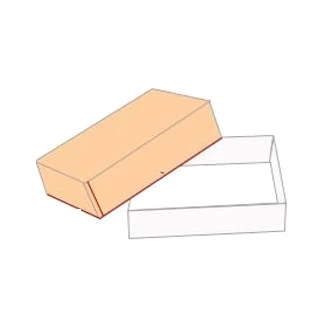
Board game packaging options — recyclable cardboard boxes for EU PPWR compliance
Lid-and-base cardboard boxes — a Grade A recyclability option for board game packaging.
What you should do: If you're designing new packaging for the EU market, target Grade A or B recyclability now. Uncoated or lightly coated cardboard, paper-based inserts, and soy- or vegetable-based inks are your safest path. Avoid mixed-material packaging unless absolutely necessary.
3. PFAS: The Upcoming Shift You Can't Ignore
What it is: PFAS (per- and polyfluoroalkyl substances) are a group of fluorinated chemicals being phased out across the EU due to their persistence in the environment and potential health effects. ECHA published a revised restriction proposal in August 2025.
Current status (mid-2026):
• The scientific evaluation is still underway, with a final decision expected by end of 2026
• Printing applications were among 8 sectors ECHA initially proposed to not restrict — but environmental groups and several member states are pushing for inclusion
• Food-contact packaging containing PFAS above threshold levels is already banned from August 12, 2026 under PPWR
• If total fluorine in your product exceeds 50 mg/kg, you must prove the fluorine comes from non-PFAS sources
Where PFAS shows up in card production:
• Water- and oil-resistant coatings on card stock (the "spill-proof" finish some brands advertise)
• Certain specialty release coatings on packaging
• Some anti-fog or anti-static treatments for plastic components
What you should do right now:
1. Ask your manufacturer to confirm whether any coating on your card stock uses PFAS-based chemistry — specifically fluorochemical water repellents
2. If your product has a "water-resistant" or "stain-resistant" marketing claim, get it tested for total fluorine content immediately
3. Start evaluating PFAS-free alternatives (silicone-based or wax-based water repellents exist, though they perform differently)
4. Don't wait for the final regulation. If you're launching a new product, spec PFAS-free coatings from the start
The regulatory direction is clear. The only question is how fast the restrictions tighten, not whether they will.
4. EN-71: If Your Game Is Played by Kids
What it is: EN-71 is the European toy safety standard. It applies to any product marketed to — or reasonably expected to be played by — children under 14 years old. It covers three parts relevant to printed card products:
• Part 1: Mechanical and physical properties (sharp edges, small parts, choking hazards)
• Part 2: Flammability
• Part 3: Migration of certain heavy metals
For card games, Part 3 is the one that generates most compliance queries. The migration limits are:
| Element | Migration Limit (mg/kg) |
| Lead | 2.0 |
| Cadmium | 0.5 |
| Chromium | 25.0 |
| Barium | 50.0 |
| Mercury | 0.05 |
| Selenium | 25.0 |
| Antimony | 10.0 |
| Arsenic | 0.2 |
These limits apply to the substrate and any surface coating — including ink layers.
What you should do: If your game could reasonably be played by children, get EN-71 Part 3 testing even if your box says "ages 14+." EU customs officers and market surveillance authorities take a broad view of what constitutes a children's product. A card game with cute illustrations and simple mechanics might be classified as a toy regardless of the age label.
5. EU Green Claims: What You Can and Cannot Say on Your Box
What it is: Starting September 27, 2026, the EU's Empowering Consumers Directive (2024/825) bans vague environmental claims on packaging. Generic terms like "eco-friendly," "green," "sustainable," or "climate-friendly" are no longer allowed unless backed by specific, verifiable evidence printed directly on the same packaging.
Banned without substantiation:
• "Eco-friendly" / "Green" / "Sustainable" / "Climate-friendly"
• Self-created sustainability logos or seals
• Implied environmental benefits through green-tinted design alone
Allowed (with evidence):
• "100% of the energy used to produce this packaging comes from renewable sources"
• FSC-certified materials (with valid chain-of-custody certificate number)
• "This box is made from 80% post-consumer recycled cardboard"
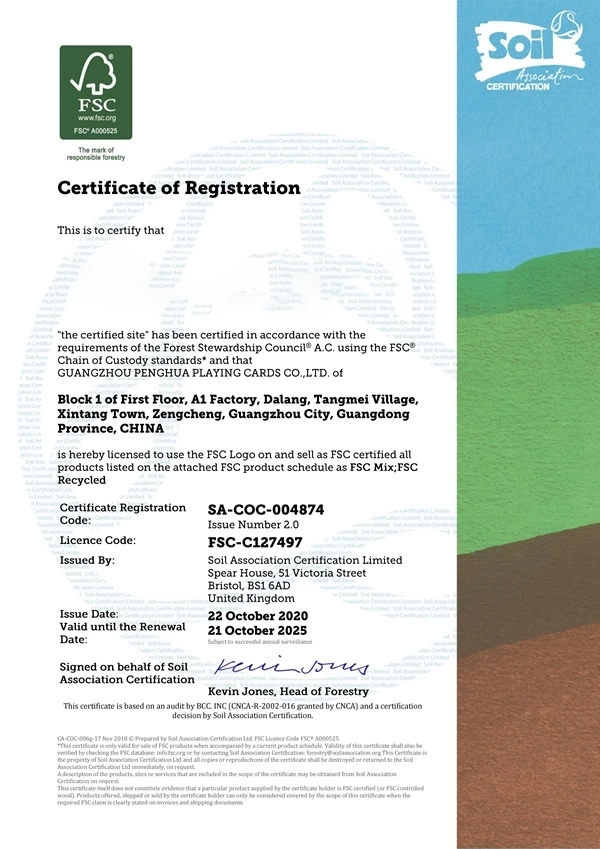
FSC certification and BSCI compliance for sustainable card game packaging
FSC certification — one of the verifiable claims you can legally make on EU-bound packaging.
What you should do: Audit your current packaging copy. Replace vague claims with specific, quantified statements. If you can't back up a claim with evidence, remove it. A QR code linking to external documentation is not sufficient on its own — the substantiation must be on the packaging itself.
Frequently Asked Questions
Do I need all five certifications for a simple deck of playing cards?
Not necessarily. For a standard adult card game with cardboard packaging, you'll definitely need REACH SVHC screening and PPWR-compliant packaging. EN-71 only applies if the game targets or could be played by children. Green Claims only matters if you make environmental statements on your box. PFAS is a watch item unless you use water-resistant coatings.
How much does EU compliance testing cost for a card game?
Typical costs: SVHC screening runs  200–400. PFAS fluorine content testing is roughly
  500–900 total for initial compliance testing. Board games with multiple component types will cost more.
My supplier says their materials are "REACH compliant." Is that enough?
No. "REACH compliant" is not a certification — it's a self-declaration with no standardized testing behind it. Ask for a third-party SVHC screening test report (from labs like SGS, TÜV SÜD, or Intertek) with results specific to the materials used in your product. Supplier declarations without test data are not defensible in an EU customs inspection.
When do I need to start worrying about PFAS restrictions on printing inks?
Now. The ECHA scientific evaluation is expected to conclude by end of 2026, and the final restriction could take effect in 2027–2028. If you're launching a new product, spec PFAS-free coatings from the start. For existing products, test your current coatings and have an alternative ready.
Your Compliance Action Checklist
Here's the practical sequence for any new card or board game product targeting the EU:
1. Determine your product type and priority — use the priority table above
2. Run an SVHC screening test on all materials (card stock, inks, coatings, adhesives, plastic components) — budget $150–300 per SKU
3. Verify ink and coating chemistry — confirm no PFAS in water-resistant or oil-resistant finishes
4. Test for EN-71 Part 3 if the game could be played by children under 14
5. Redesign packaging for recyclability — target Grade A or B under PPWR; avoid mixed materials
6. Audit your environmental claims — remove vague "green" language; replace with specific, substantiated statements
7. Confirm FSC chain-of-custody if claiming FSC-certified materials
8. Set a calendar reminder — re-run SVHC and material tests whenever the Candidate List updates (roughly every 6 months)
How We Handle This at Yuyoung

Yuyoung card game manufacturing facility in Shenzhen — BSCI, FSC, Disney, ISO certified
Yuyoung's 30,000 sqm manufacturing facility in Shenzhen, serving clients across 150+ countries.
At our factory in Shenzhen, we've built compliance testing into our standard workflow for EU-bound orders. When a client places an order for the European market, we automatically:
• Request updated material safety data sheets (MSDS) for every ink, coating, and adhesive in the production run
• Run SVHC screening through a third-party lab (we work with SGS and TÜV SÜD)
• Provide EN-71 Part 3 test reports for any children's game project
• Advise on packaging material choices that align with PPWR recyclability targets
• Maintain FSC-certified paper stock (FSC-C128716) as a standard option
We've held [BSCI, Disney, FSC, ISO 9001, ISO 14001, ISO 45001, and SQP certifications](https://www.yuyoung.com/company-profile) for years — but the real value isn't the certificates themselves. It's the internal process that keeps us ahead of each regulatory update before it hits our clients' shipments.
If you're planning a European launch for your card game, TCG, or board game and want to avoid the Rotterdam scenario — get in touch and we'll walk you through the compliance checklist for your specific product.
Written by Nina He
R&D Director at Yuyoung | 12+ years in card & board game materials research