Black Core vs Blue Core vs Gray Core vs Art Paper: Which Card Stock Is Best for Your Custom Card Game?

Publish Time:

If you’ve spent three months perfecting your card game prototype, the last thing you want is for it to feel cheap in someone’s hands. Yet this is exactly what happens when creators pick the wrong card stock—often because they didn’t understand the difference between black core, blue core, gray core, and art paper in the first place.

I’ve watched this mistake play out at our factory floor more times than I’d like to admit. A Kickstarter creator flies in for sampling, shuffles a deck of 300gsm art paper cards, and asks, “Why do these feel different from Bicycle cards?” The answer always comes back to core construction.

This guide cuts through the marketing noise. We’ll break down each card stock type by what it’s actually made of, how it performs during gameplay, and—most importantly—which scenarios justify the extra cost. By the end, you’ll know exactly what to specify when you submit your next order to a custom card games manufacturer.

What Makes Card Stock Different: The Core Truth

Before diving into specific types, let’s talk about why card stock matters more than most creators realize.

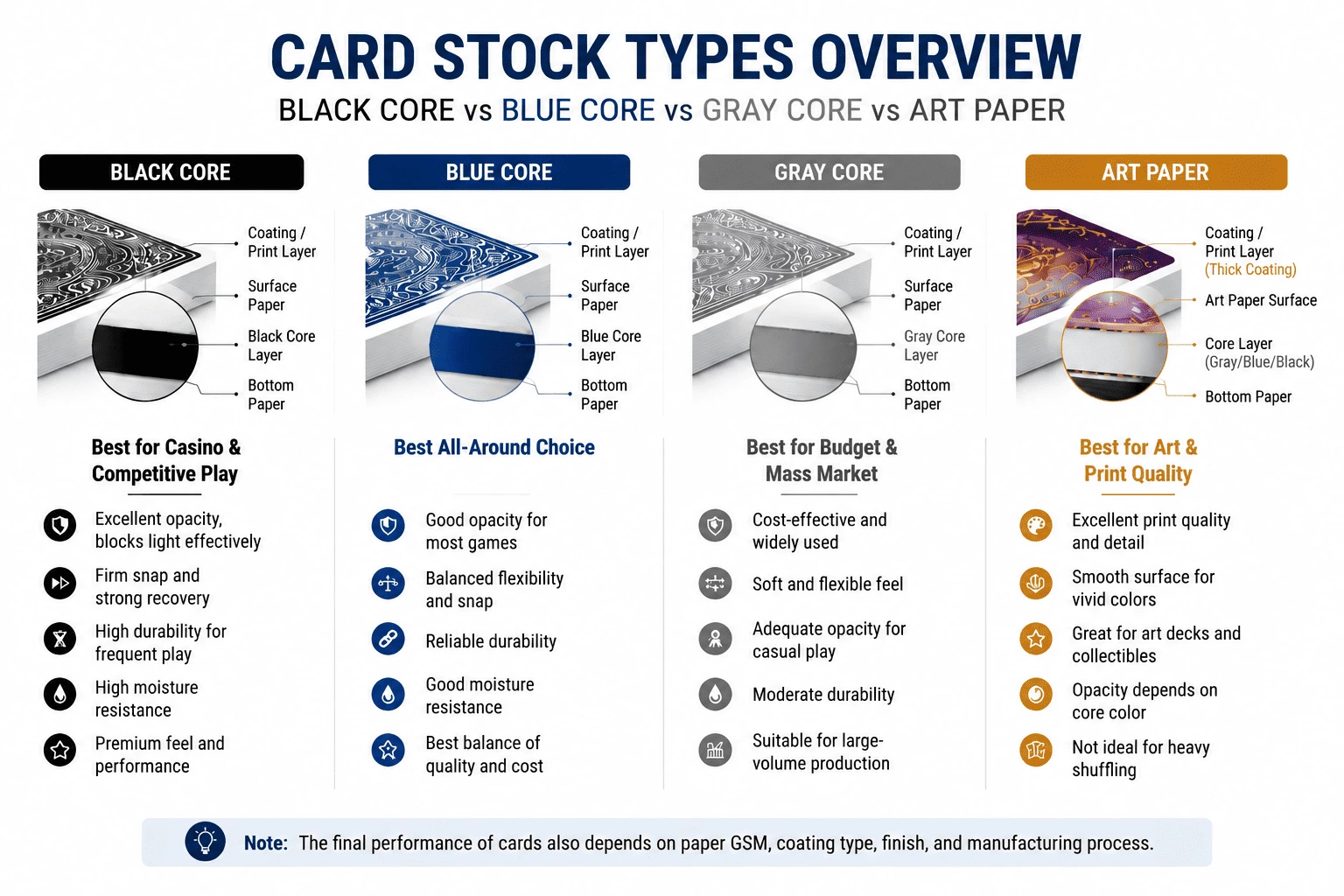
A playing card isn’t just paper with printing on it. It’s a composite structure—typically two layers of paper bonded around a central “core” material. This core determines three things that matter enormously during actual gameplay:

  • Opacity: Whether you can see the card design through the back when holding it up to light
  • Snap and flexibility: How the card feels when you riffle shuffle versus how it springs back
  • Durability: How many shuffles, bends, and spills the deck can survive

[Photo: Cross-section diagram showing layered card construction with labeled core layers]

Here’s what most articles won’t tell you: the “color” of core paper (black, blue, gray) refers to the color of the central core layer visible when you look at the card’s edge or hold it against bright light. It has nothing to do with the card’s surface color or artwork. Two decks with identical artwork can feel dramatically different because of what runs through their middle.

Black Core Card Stock: The Casino Standard

Black core is what you’ll find in high-end poker rooms and casino tables worldwide. Walk into any Vegas casino and the cards shuffling in front of you are almost certainly black core.

What it actually is: Black core card stock uses paper pulp that has been dyed black (or near-black) during manufacturing. The core material itself is typically a combination of wood pulp and synthetic fibers, with carbon black pigment added during the pulping stage. This isn’t a coating—it’s intrinsic to the core layer.

Technical specs: GSM typically ranges from 280-310gsm for standard poker-sized cards. The core layer itself accounts for roughly 15-20% of total thickness.

Opacity performance: Excellent. Hold a black core card up to direct sunlight and you’ll struggle to see anything through it. This matters because in competitive play, opponents shouldn’t be able to peek at your hand through ambient light or table lamps. We test every batch by holding cards 6 inches from a 100-watt bulb—at Yuyoung, our QC team rejects any sheet showing visible light transmission.

Shuffle feel: This is where black core truly shines. The slightly stiff snap combined with just enough flexibility creates that satisfying “thwack” when you bridge a deck. It riffle shuffles smoothly without catching or sticking, yet bends enough for one-handed shuffles. After 50+ shuffles in our stress tests, black core decks maintained structural integrity far better than other core types.

Durability: In our production data, black core decks average 3-4x more shuffles before showing visible wear compared to uncoated alternatives. The synthetic fiber content in quality black core resists moisture absorption, which means these cards handle humid environments better too.

Best for: Poker, blackjack, casino-grade card games, competitive TCGs, premium products where the client expects 500+ shuffles per deck, any game where card opacity affects gameplay integrity.

Price positioning: Black core sits at the premium end. Expect to pay roughly 40-60% more than gray core equivalents. For a deck that needs to last through hundreds of game nights, the math often works out.

The catch: Not all black core is equal. We occasionally receive artwork files from clients who ordered “black core” from another supplier and found cards with gray-tinted cores or inconsistent opacity. The pigment concentration in the core layer varies wildly between manufacturers. If black core performance matters for your project, verify your supplier’s quality control process—or better yet, request a light transmission test during sampling.

Blue Core Card Stock: The Balanced Performer

Blue core occupies a fascinating middle ground in the market. It’s not as premium as black core, but it offers noticeably better performance than gray core or uncoated stock.

What it actually is: Blue core uses paper pulp dyed with blue pigment during manufacturing. The fiber composition typically mirrors black core—wood pulp with synthetic reinforcement—but the dye process differs. Blue cores often use Phthalo blue or similar organic pigments that penetrate the fiber more evenly than carbon black.

Technical specs: GSM ranges from 270-310gsm, with most production falling around 285-300gsm for poker-size cards. The core layer represents 12-18% of total thickness.

Opacity performance: Very good, though not quite casino-grade. Blue core cards block most ambient light, and under normal indoor lighting conditions, you won’t see artwork bleed-through. The difference from black core becomes visible only when you hold cards against strong direct light or attempt to read through them deliberately. For casual and semi-competitive play, this opacity level is entirely sufficient.

Shuffle feel: Slightly softer than black core. The “snap” is there, but with a more pronounced flex. Players who prefer a buttery shuffle over a crisp bridge will actually prefer blue core. It doesn’t fight your hands during one-handed shuffles quite as much. We’ve had clients specifically request blue core because their focus group testers kept complaining about black core being “too stiff.”

Durability: Solid. Blue core decks in our testing averaged 2-3x the shuffles of uncoated stock. The blue dye process actually adds a small amount of moisture resistance compared to undyed cores, though this benefit is marginal compared to black core’s synthetic fiber content.

Best for: Board game components, casual TCGs, starter decks, educational card sets, tarot decks where tactile feel matters, any project where black core pricing feels prohibitive but gray core feels like a step backward.

Price positioning: Typically 20-35% above gray core pricing. For many indie developers and Kickstarter projects, this represents the sweet spot between cost and quality.

Where blue core struggles: If your game involves any form of card transparency as a mechanic, or if players regularly hold cards against light sources (outdoor play, bright table lamps), blue core’s limitations become visible. Also, the blue tint can occasionally bleed into adjacent paper layers if the lamination process isn’t precisely controlled—this is a quality control issue, not an inherent flaw of the core type.

Gray Core Card Stock: The Budget Workhorse

Gray core is what happens when you need functional cards at a price point that makes sense for mass-market board games. It’s the default choice for Hasbro, Ravensburger, and most major game publishers for their standard products.

What it actually is: Gray core uses undyed or lightly tinted paper pulp. The “gray” comes from a mix of bleached and unbleached fibers, sometimes with small amounts of gray pigment. The key difference from black and blue cores is that gray core typically contains less synthetic reinforcement, making it more purely paper-based.

Technical specs: GSM typically ranges from 250-290gsm. The thinner profile is partly why gray core cards feel noticeably more flexible than their black or blue core counterparts.

Opacity performance: Adequate for indoor play under normal lighting. Hold gray core cards against bright light and you’ll see clear light transmission. In practice, this rarely matters for most board games—you’re playing at a table, not holding cards against a window. However, for two-player games where one player holds their entire hand fanned out near a lamp, the reduced opacity becomes noticeable.

Shuffle feel: Soft and flexible. Some players love this—the cards almost “flow” during shuffles. Others find it too limp, especially for riffle shuffling. Bridge technique becomes challenging because the cards don’t spring back with the same crispness. In our experience, gray core divides players based on shuffling style preference.

Durability: Functional but not exceptional. Gray core decks handle 200-400 shuffles before showing wear in our testing. The paper-heavy composition means higher moisture sensitivity compared to synthetic-reinforced cores. Spilled drinks, humid environments, and bent corners all take their toll faster.

Best for: Mass-market board games where unit economics drive decisions, promotional decks, limited-run indie games with tight budgets, educational purposes where cards get heavy daily use and replacement cost matters, any project where the target retail price requires minimizing per-unit production costs.

Price positioning: The baseline. Gray core pricing typically sets the floor for “quality” card stock. If you’re comparing suppliers and one offers black core pricing at gray core rates, be suspicious—either the quality control is poor or you’re not actually getting what was promised.

The honest trade-off: Gray core isn’t “bad” card stock. It serves millions of players daily through mass-market games. The question is whether your project’s requirements justify the upgrade. If your game will see 50 plays maximum per deck, gray core might be the right choice. If you’re designing a tournament-grade TCG meant to last hundreds of matches, it’s a false economy.

Art Paper (Coated/CuP Paper): The Surface-First Option

Art paper—sometimes called CuP (coated under paper) or simply “art paper” in the industry—takes a fundamentally different approach. Rather than focusing on core construction, art paper optimizes the surface coating for print quality.

What it actually is: Art paper uses a standard gray or white core (the “under” in CuP) with a heavy coating on the surface designed for high-fidelity printing. The coating typically contains kaolin clay, calcium carbonate, and binding agents that create an ultra-smooth surface接受的printing surface. This is the same technology used in high-end magazines and art books.

Technical specs: GSM typically ranges from 300-400gsm for playing cards. The extra weight compensates for the thinner core relative to black/blue core alternatives. Surface coatings usually add 15-25gsm per side.

Opacity performance: Variable. Art paper with a white core offers decent opacity but not at black core levels. Art paper with a gray core performs similarly to gray core card stock. The surface coating has nothing to do with light blocking—it’s purely a printing substrate.

Shuffle feel: This is where art paper divides the community. The coated surface creates a distinctive glide that some players love and others find too slippery. Cards shuffle smoothly but can feel “slick” rather than having that classic paper-on-paper friction. After extensive use, the coating can develop a slightly waxy feel that changes the tactile experience.

Durability: The coated surface offers excellent scuff and scratch resistance—your artwork stays pristine longer. However, the coating itself can crack if cards are flexed sharply in cold temperatures. We’ve seen art paper cards delaminate at corners when stored in unheated warehouses during winter shipping.

Best for: Tarot decks and oracle cards where artwork reproduction quality is paramount, art-focused card games where the visual experience matters more than shuffle performance, limited-edition collectible decks where print quality justifies the tactile trade-offs, promotional items and display pieces rather than heavy-use game components.

Price positioning: Similar to or slightly above gray core pricing. The cost premium over gray core is modest because the differentiation comes from surface treatment rather than core construction.

The irony of art paper: It’s often chosen for its premium feel, but serious card players frequently prefer the tactile experience of uncoated card stock. If your target audience is competitive gamers or cardists (people who practice card flourishes), art paper might receive backlash for being “too slippery.” Know your audience.

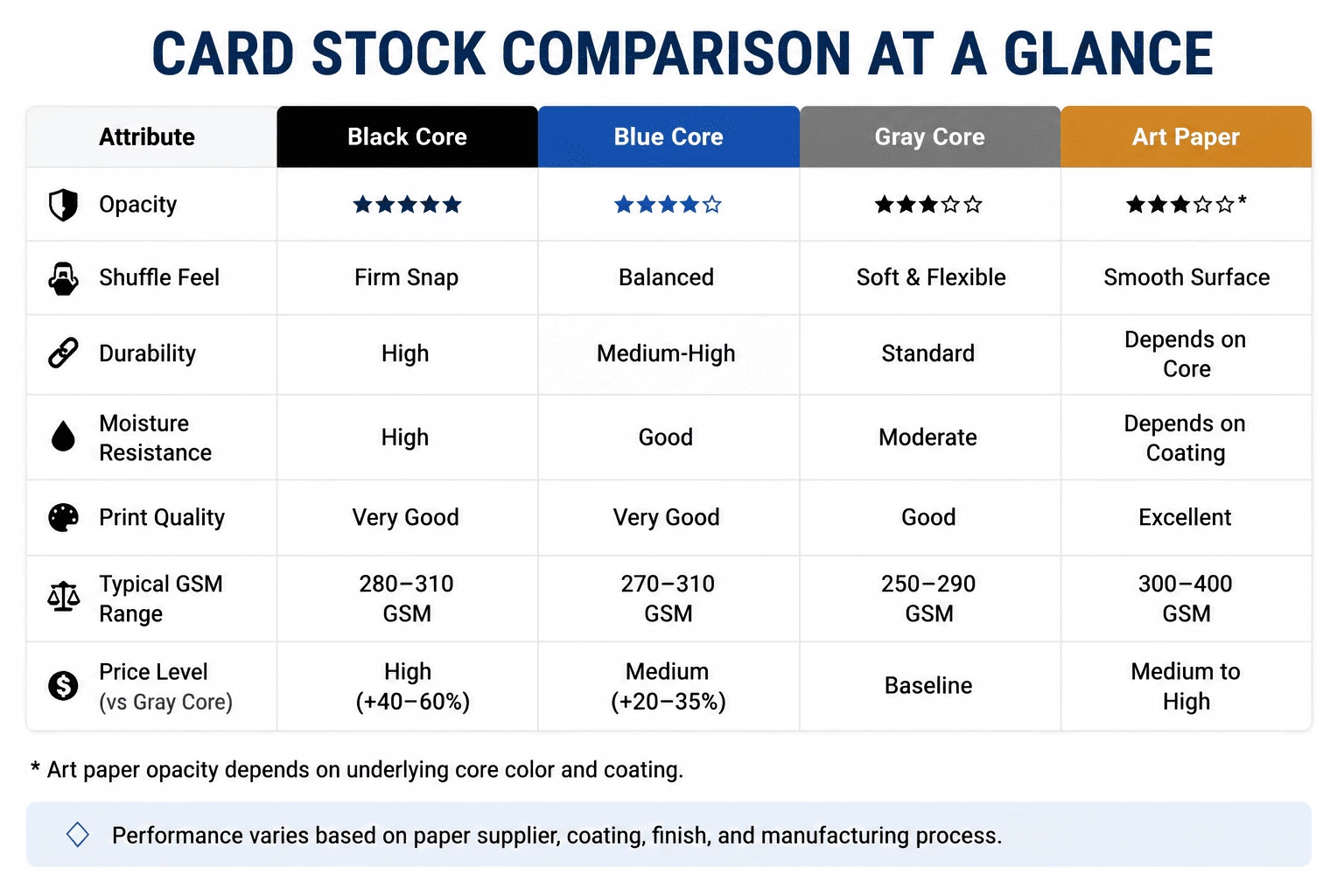
Card Stock Comparison at a Glance

Attribute Black Core Blue Core Gray Core Art Paper
Core Color Black Blue Gray/White Gray/White (coated)
Typical GSM 280-310 270-310 250-290 300-400
Opacity ★★★★★ ★★★★☆ ★★★☆☆ ★★★☆☆
Snap/Response Excellent Very Good Moderate Good
Shuffle Feel Crisp, responsive Smooth, flexible Soft, limber Slick, glide
Durability (Shuffles) 800-1500+ 500-800 200-400 300-500
Moisture Resistance Excellent Good Moderate Variable
Print Quality Very Good Very Good Good Excellent
Price Level Premium Mid-Premium Budget Budget-Mid
Primary Use Case Casino/tournament Board games/TCG Mass-market Art/tarot

Based on production data from our 30,000+ sqm facility; individual results vary by manufacturer and specific paper formulations.

The Quick Decision Tree: Which Card Stock Should You Choose?

Not sure where to start? Work through these questions:

1. What’s your retail price point? - Above $20 per deck → Black core or premium art paper - $10-20 per deck → Blue core or quality gray core - Below $10 per deck → Gray core or art paper

2. How many times will each deck be shuffled? - 500+ shuffles expected → Black core - 100-500 shuffles → Blue core - Under 100 shuffles → Gray core or art paper

3. Does card opacity affect your gameplay? - Yes, absolutely (gambling, competitive card games) → Black core only - Somewhat (some strategy games) → Black or blue core - Not really (cooperative games, party games) → Any core type

4. Who is your target audience? - Competitive gamers/cardists → Black or blue core (avoid art paper) - Casual players/families → Blue or gray core - Art collectors/occult enthusiasts → Premium art paper - Educational institutions → Gray core (budget-friendly replacement cycles)

5. What’s your production volume? - Under 500 decks → Blue core (flexibility for smaller runs) - 500-5000 decks → Blue or black core (economies of scale kick in) - 5000+ decks → Any option viable; choose based on above factors

[Photo: Decision tree flowchart showing card stock selection process based on use case]

Real-World Selection: What Different Clients Choose

Over 19 years of manufacturing custom card games, we’ve noticed clear patterns in client selections. These aren’t rules—your project might genuinely require something different—but they represent the most common starting points.

Kickstarter TCG projects typically land on blue core. The price point needs to remain accessible for backers, but the competitive nature of TCG play demands durability and opacity. We’ve produced hundreds of TCG launches, and roughly 65% settle on blue core after testing samples.

Board game publishers lean heavily toward gray core for mass-market titles and blue core for premium lines. The economics of board games—with their multiple card components—mean that even a $0.05 difference per card multiplies quickly. A 200-card game saves $10 per unit at gray core pricing, which can mean the difference between profit and loss at retail.

Tarot and oracle deck creators almost universally choose art paper or black core. The artwork is the product; print quality trumps shuffle feel. That said, we see increasing interest in black core tarot decks from practitioners who prefer the tactile experience of casino-grade cards.

Casino and poker room suppliers require black core—there’s no substitute. We work with several gaming equipment distributors who won’t accept anything less than full opacity certification and minimum snap resistance standards.

Educational and training applications consistently choose gray core. Cards get shuffled thousands of times, often by people who aren’t careful with them, and replacement cost matters. Gray core provides adequate performance at a price that makes sense for institutional budgets.

Common Mistakes We See (And How to Avoid Them)

Mistake 1: Choosing black core for the wrong reasons Some clients specify black core because it sounds premium, without considering whether their game actually benefits. If you’re making a cooperative party game where cards rarely leave the table and shuffling happens once per session, black core pricing is wasted money. Save it for your next tournament-grade TCG.

Mistake 2: Assuming “core color” affects surface appearance We’ve had clients panic during sampling, asking why their red-backed cards show a dark edge. The core color is internal—it shouldn’t affect your artwork at all. If you’re seeing core color bleed into your surface design, that’s a lamination or trimming quality issue, not a core selection problem.

Mistake 3: Ignoring finish interaction with core type The paper core isn’t the only variable. Linen texture, smooth finish, and applied coatings all interact with core stiffness. A blue core card with heavy linen texture will feel stiffer than a black core card with smooth finish, even though the core material suggests the opposite. Always request samples with your actual finish specification.

Mistake 4: Underestimating humidity effects Cards shipped from a humid climate (like Shenzhen) to a dry climate (like Colorado in winter) will warp slightly as they lose moisture. This affects all paper types, but thinner gray core cards warp more noticeably. If your product ships internationally, consider this when specifying GSM and core type.

Mistake 5: Forgetting packaging when specifying card stock The tuck box or blister packaging affects perceived quality as much as the cards themselves. A deck of blue core cards in a flimsy tuck box looks cheaper than gray core cards in a premium box. Coordinate your board game packaging choices with your card stock selection—these decisions should be made together, not independently.

Quality Verification: What to Check During Sampling

Before committing to full production, run these checks on your samples:

Light test: Hold each card individually 6 inches from a bright light source. No visible artwork transmission through the card back.

Shuffle test: Perform 100 riffle shuffles and 50 bridge shuffles. Cards should show no visible delamination, cracking, or surface wear.

Flex test: Bend each card to 90 degrees and hold for 10 seconds. Release and check for creasing or cracking at the bend line.

Water test: Place a single drop of water on the card surface. Note absorption time and any resulting warping. Quality card stock should resist immediate absorption.

Snap test: Drop a single card on a hard surface from 6 inches. It should produce an audible snap and lie flat, not curl or flutter excessively.

[Photo: Factory QC team performing light transmission test on card samples]

Making Your Final Decision

Here’s my honest recommendation based on years of watching what works and what doesn’t:

If you’re launching a premium product where card quality reflects on your brand, start with blue core as your baseline. It’s the most versatile option, performs well across most game types, and prices accessibly enough for most Kickstarter budgets.

If you’re building a competitive TCG or any game where card integrity affects gameplay, invest in black core. Yes, it’s more expensive. But a card that fails during a tournament—delaminating, showing through, wearing unevenly—is a worse experience than a slightly cheaper product that works reliably.

If you’re producing mass-market games for retail, gray core is perfectly fine. Don’t let anyone tell you it’s “inferior” for standard board games. It serves millions of players daily. Match it with quality custom card games production processes, and your players will never complain.

If print quality is your primary differentiator, consider art paper with a black or blue core underneath. Yes, this combination exists and works well—the coating provides your premium artwork surface while the colored core gives you opacity and durability. It costs more than standard art paper, but less than you might expect for the performance gain.

Ready to Move Forward?

Card stock selection isn’t the most glamorous part of game design, but it might be the most important functional decision you make. A brilliant game with flimsy cards gets bad reviews. Adequate gameplay with premium-feeling cards builds loyal fans.

At Yuyoung, we maintain relationships with paper mills specifically to ensure consistent core material availability. Our 19 years in the industry means we’ve worked through enough supplier transitions to know which mills deliver predictable quality—and which cut corners that show up six months into mass production.

As an FSC-certified card manufacturer, we can also help you navigate sustainability requirements if your brand or retail partners require certified materials. FSC certification doesn’t mean sacrificing performance—some of our best-selling card stocks carry the FSC mark.

If you’re still unsure which card stock fits your project, reach out before ordering samples. A 15-minute conversation about your game mechanics, target audience, and price point can save you from ordering the wrong samples twice. We see it happen often enough that we now offer complimentary pre-order consultations for projects over 1,000 units.

Your cards will be shuffled thousands of times by people who never think about paper construction. Make sure they never have to.

Related News

How to Choose the Right Paper Stock and Finish for Custom Tarot Cards

How to Choose the Right Paper Stock and Finish for Custom Tarot Cards

If you’ve ever held a mass-market tarot deck and then picked up a premium artisan deck, you know the difference isn’t just in the artwork—it’s in the ...
From Concept to Shipping: The Complete Custom Card Game Manufacturing Process

From Concept to Shipping: The Complete Custom Card Game Manufacturing Process

If you’ve ever held a professionally printed deck of cards and wondered how it went from a sketch on someone’s desk to that perfectly cut, flawlessly ...
Matte, Glossy, Linen, Foil Stamped: A Complete Guide to Card Game Surface Finishes

Matte, Glossy, Linen, Foil Stamped: A Complete Guide to Card Game Surface Finishes

Most game designers obsess over mechanics, theme, and artwork. They spend weeks perfecting the card illustrations, agonize over the rulebook wording, ...

// YuyoungTell Us Your Requirements

We are a global printing expert with 20 years of experience, specializing in providing customized, cost-effective printing solutions and comprehensive service support.

Contact us

Please send your information to us and give you feedback in time.

This site uses cookies

We use cookies to collect information about how you use this site. We use this information to make the website work as well as possible and improve our services.more details